
Criminal Court Records in Leelanau County
A criminal court record is the case file a court builds after the state accuses a person of a crime. It opens when a charge is filed and grows with each event that follows. The file holds the charges as written, the defendant's pleas, motions from both sides, hearing dates, and the outcome. In Leelanau County these files stay with the court that hears the case. The register of actions inside each file is the running log of everything the court did.
Two trial courts handle criminal matters here. The 86th District Court takes misdemeanors and the early stages of every felony, from arraignment through the probable cause conference and the preliminary examination. Felonies that clear those stages move up to the 13th Judicial Circuit Court, which serves Leelanau, Antrim, and Grand Traverse Counties and tries the most serious cases. A single case can leave records in both courts, so a full picture often means checking each level.
Charges never start on their own. The Leelanau County Prosecuting Attorney reviews the police report and decides what to file, which places the prosecutor's office at the center of every criminal case. You can review the Leelanau County Prosecuting Attorney page for the office address, phone, and hours.
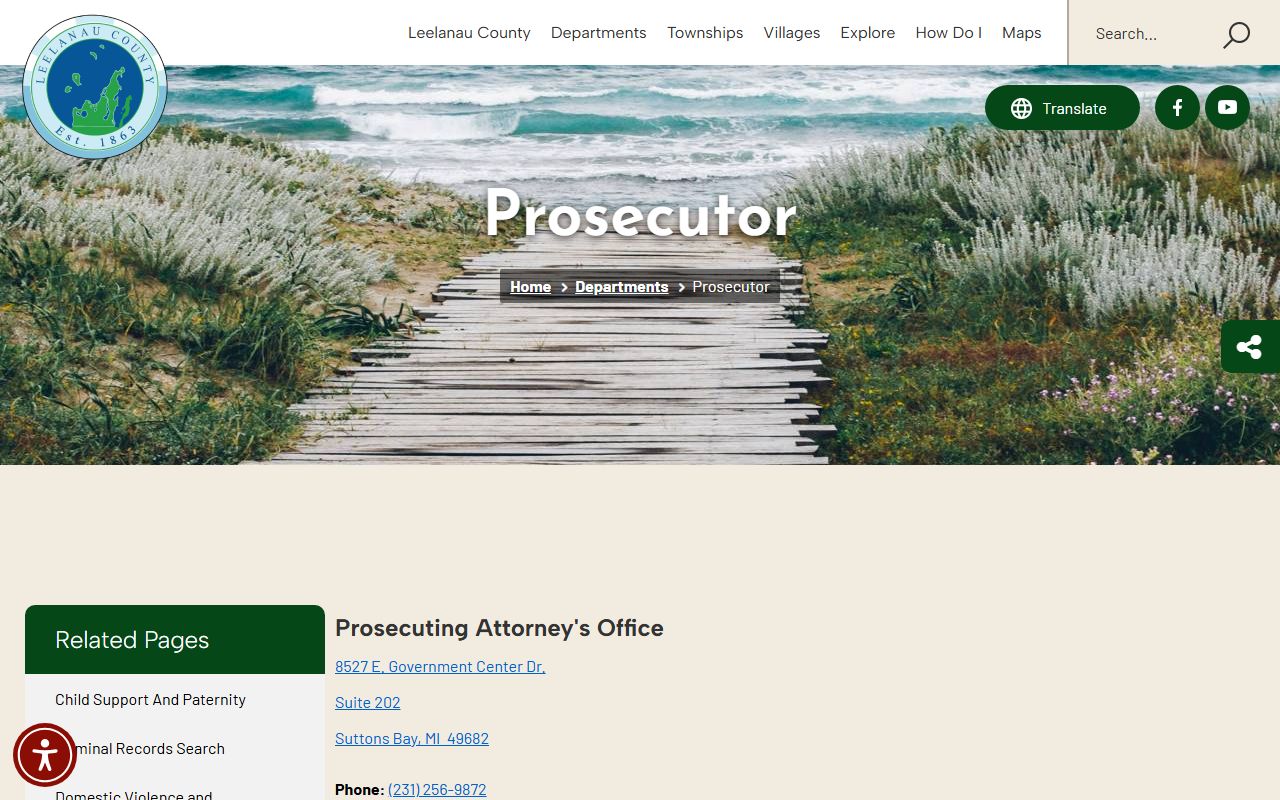
Because the prosecutor frames the counts, the charge language in the court file usually mirrors the warrant request the office approved. The county's arrest records and court charges page looks closer at those charges, while the full outcome and sentence stay with the case file described here.
How to Search Leelanau County Criminal Court Records
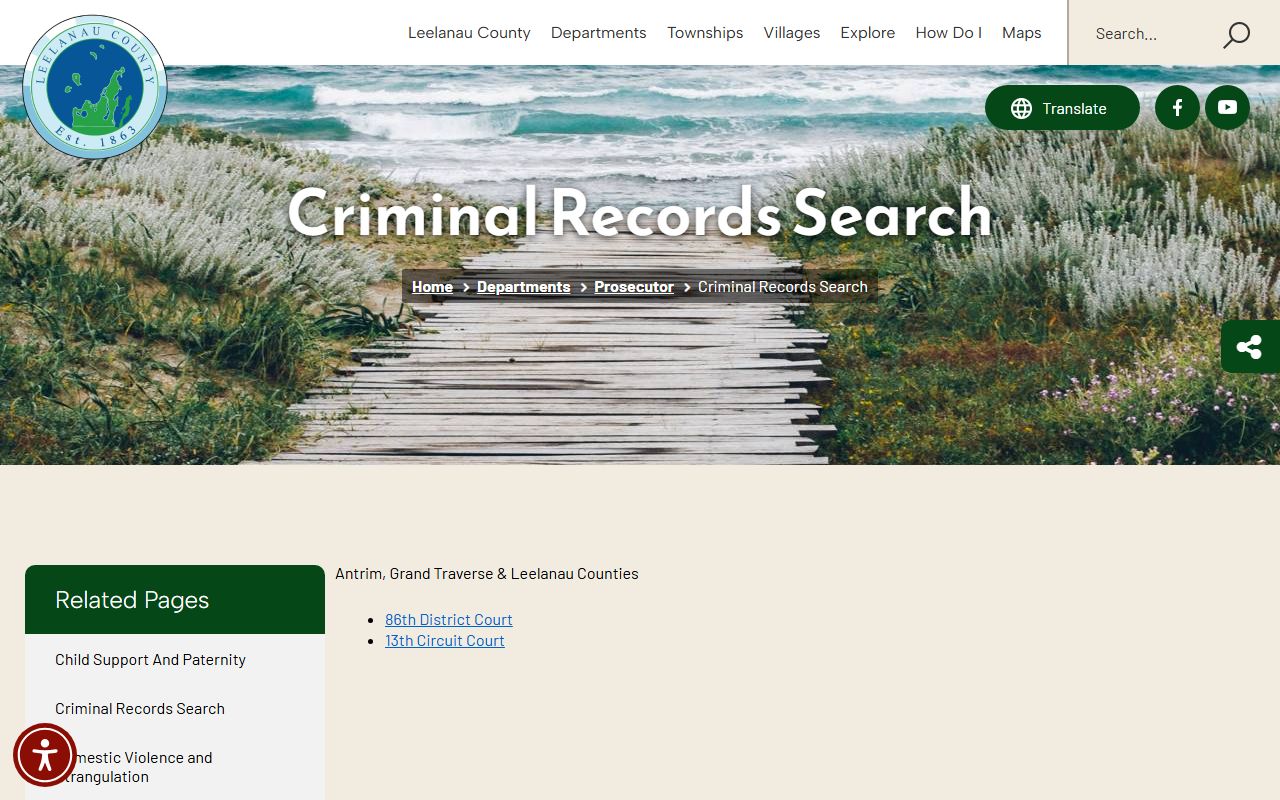
Most searches start online. The MiCOURT Case Search portal is the statewide entry point, and it can show criminal, civil, traffic, and probate cases depending on the court. You can open the MiCOURT Case Search portal and pick a court before you run a name or case-number query. The 86th District Court also posts case and calendar links, and the county prosecutor keeps a page that routes you to the district and circuit record tools.
The prosecutor's criminal records page gathers those links in one place. You can use the Leelanau County criminal records search page to reach the 86th District Court and 13th Circuit Court record systems.
A short, ordered path keeps the search clean:
- Open MiCOURT or the prosecutor's criminal records page and choose the court that fits the charge level.
- Search by the defendant's name, or by case number if you already have it.
- Narrow the results by court, case type, and filing date when the portal allows it.
- Open the case to read the register of actions, the charges, and the disposition.
- Request a certified copy from the court clerk when you need the document itself.
Certified copies come from the court that holds the file. The 86th District Court uses a file review and copy request form, and you can reach the 86th District Court file review and copy request for its fees and rules. Older criminal cases can be harder to view online, because the district court paused extracting some criminal cases to its website during an automatic set-aside reconciliation.
Stages of a Leelanau County Criminal Case
A criminal case moves through set stages, and each one leaves its own mark on the record. The first entries name the charges and the defendant. Later entries log every hearing, ruling, and change until the case closes. Reading a file in order shows how the accusation was tested and how it ended.
Case flow: Charges Filed › Arraignment › Probable Cause Conference / Preliminary Exam › Bindover › Plea or Trial › Disposition › Sentencing
Felonies pass through the district court first for their early stages, then move to circuit court once a judge finds enough evidence to proceed. Misdemeanors stay in the district court from start to finish. The table below sums up what happens at the main steps.
| Stage | What Happens |
|---|---|
| Arraignment | The court reads the charges, the defendant enters a first plea, and bond is set. |
| Probable Cause Conference / Preliminary Exam | In felony cases the district court checks whether the evidence supports the charge before the case can advance. |
| Bindover | A felony that clears the exam is sent up to the 13th Circuit Court for trial. |
| Plea or Trial | The case ends in a plea, or a judge or jury weighs the evidence and reaches a verdict. |
| Sentencing | After a plea or guilty verdict the judge sets the penalty, from fines and probation to jail or prison. |
What a Leelanau County Criminal Court Record Shows
Once a case opens, the file collects a standard set of fields. Some name the people and the court. Others track the charges and the money owed. Michigan court rules keep certain personal details off the public version, so a birth date or a Social Security number will not appear in the open file.
| Field | What It Shows |
|---|---|
| Case Number | The court's unique file ID; the two-letter code at the end flags the case type. |
| Defendant | The person accused, plus the assigned judge or magistrate and the attorneys. |
| Charges | Each count, its offense date, and the Michigan statute the count is built on. |
| Plea | How the defendant answered each charge, such as guilty, not guilty, or no contest. |
| Disposition | The outcome of each count, from dismissal or acquittal to conviction. |
| Sentence | The penalty imposed, including jail, probation, fines, costs, and restitution. |
The register of actions ties these fields together. It lists every filing, hearing, order, and payment by date, so the docket reads like a timeline of the case. Protected personal identifying information stays on nonpublic forms under the state court rules.
Note: A two-letter suffix on a Michigan case number marks the case type, so it tells you whether a file is criminal, civil, traffic, or family before you open it.
Charges Compared With Convictions
Being charged is not the same as being convicted. A charge is only an accusation, and the record can show counts that were later dropped, dismissed, or ended in an acquittal. A conviction means a plea or a verdict settled the count against the defendant. Reading the disposition beside each charge keeps the two apart.
| Charge | Conviction | |
|---|---|---|
| Stage | Accusation | Verdict or plea |
| Burden of Proof | Probable cause | Beyond a reasonable doubt |
| Public Record | Yes | Yes |
The gap matters for anyone reading a file for a background reason. A long charge list can shrink to a single conviction, or to none at all, so the final disposition is the line that counts.
ICHAT and the Leelanau County Criminal File
Michigan runs a statewide name-based criminal history search called ICHAT, and it is a different thing from a county court file. ICHAT pulls public conviction history from across the state. A court file holds one case in full, including motions and hearings ICHAT never shows. You can reach the search through the Michigan State Police ICHAT portal, though a fee and a login may apply.
The Michigan State Police also explain what the tool does and does not cover. You can read the Michigan State Police criminal history records page for its rules on fingerprints, set-aside records, and the offender tracking system.
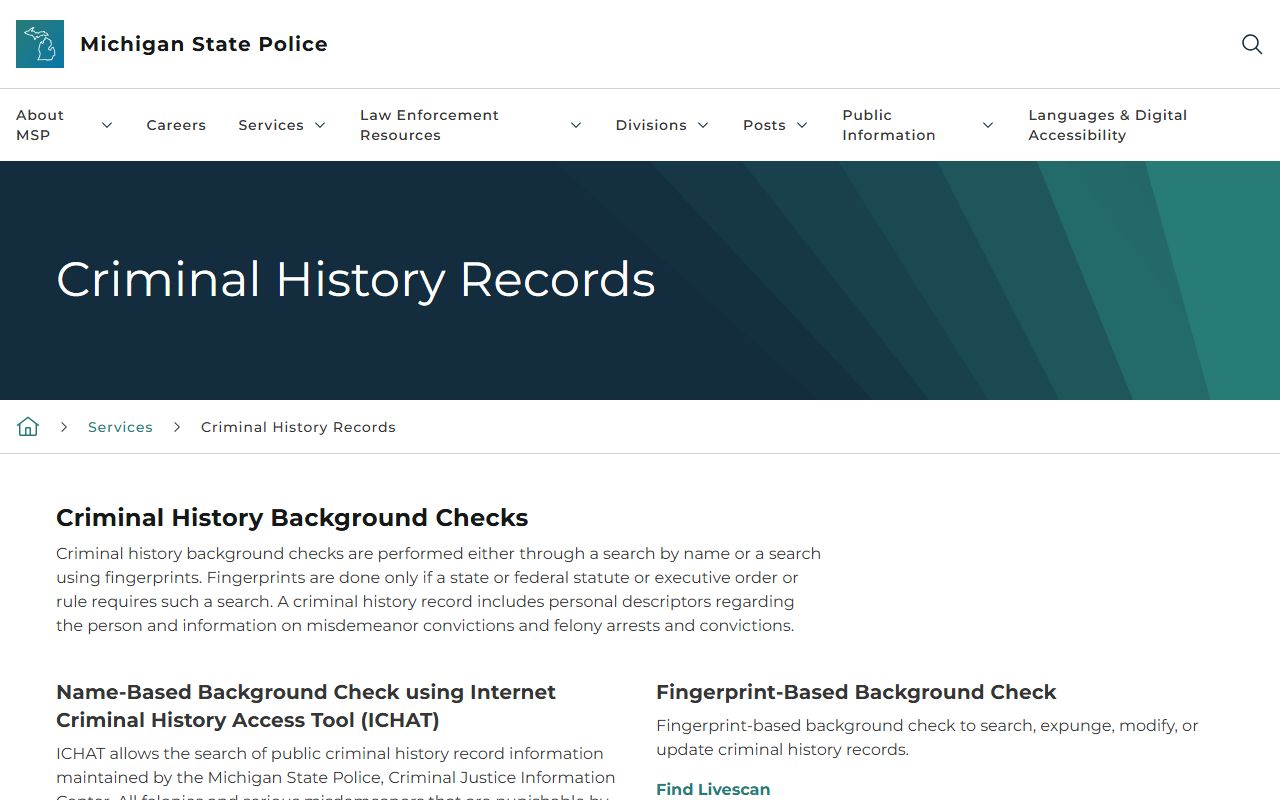
ICHAT covers felonies and serious misdemeanors punishable by more than 93 days, but it leaves a lot out. It does not show warrants, juvenile records, traffic records, local misdemeanors, tribal records, federal records, or out-of-state history. For those, the court file or the agency that holds the record is the better source. State prison time, by contrast, shows on the Department of Corrections offender search.
That Corrections tool tracks people under state supervision. You can search the Michigan Department of Corrections OTIS system for prisoners, parolees, and probationers, though it does not cover the county jail.
Reading Dispositions and Sentences
The disposition is the outcome line, and it is the part of the file most readers want. A guilty plea, a jury verdict, a dismissal, or an acquittal each closes a count in a different way. A no contest plea resolves the case without an admission of guilt. Some counts end in a deferral, where the court holds judgment while the defendant meets set terms.
The sentence follows a conviction and spells out the penalty. It can mix jail or prison time with probation, fines, court costs, and restitution to a victim. Probation keeps a person in the community under rules the court sets. Because the money terms and the supervision terms both live in the record, the file shows not only the outcome but what the defendant still owes or must do.
Sealed and Set-Aside Criminal Records
Michigan does not use the word expungement in its statutes. The state calls the process a set-aside, though most people mean the same thing. A sealed record is hidden from ordinary public view but still exists for limited official use. A set-aside conviction is treated by law as though it never happened for most purposes, which cuts public access far more sharply.
| Sealed | Set-Aside (Expunged) | |
|---|---|---|
| Visibility | Hidden from public view | Treated as though it never occurred |
| Law Enforcement | Limited access remains | Access allowed only as the statute permits |
| Eligibility | Set by court order or rule | Set by MCL 780.621 and the Clean Slate law |
The effect of a set-aside is written into state law. You can read Michigan MCL 780.623 for how a set-aside limits who may see the conviction afterward.
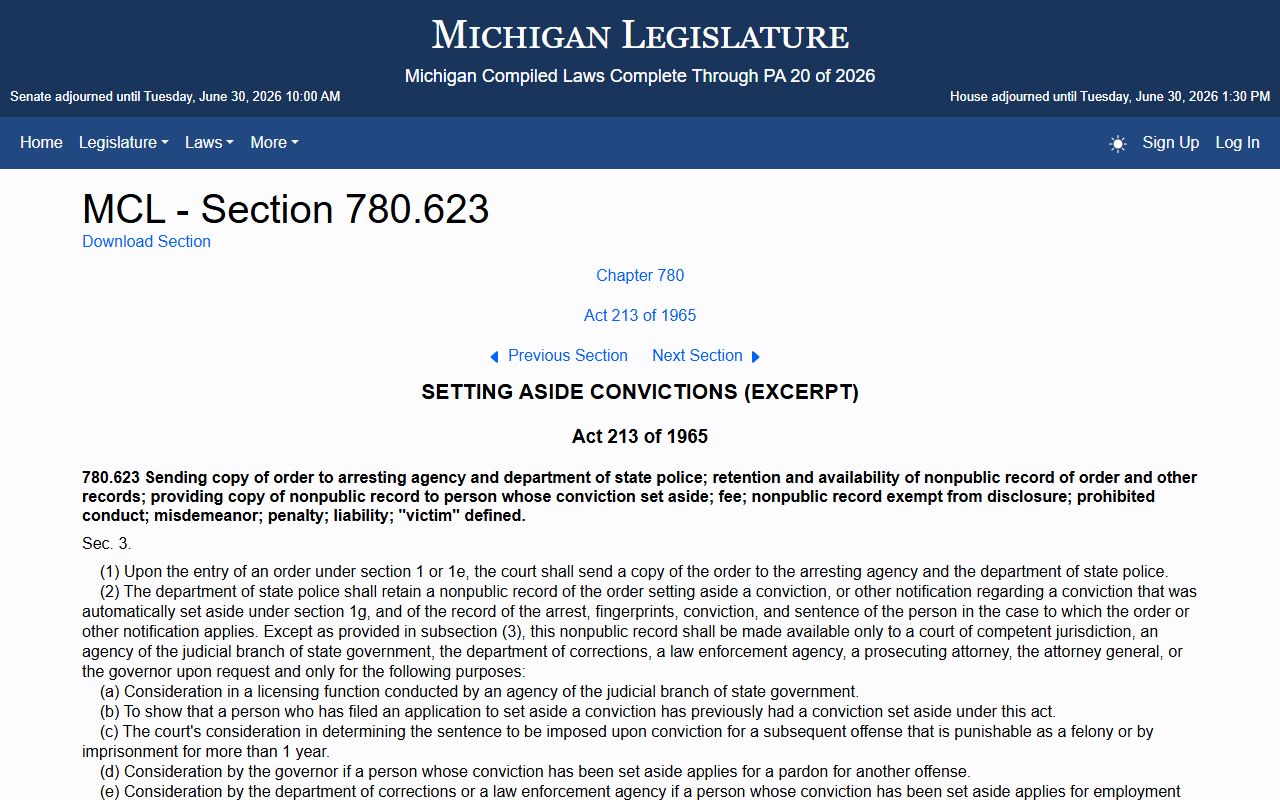
After a conviction is set aside, public access drops, but the subject and some agencies may still reach the record as the law allows. That is why a set-aside case can vanish from a routine search yet still surface in a licensing or law-enforcement check.
Setting Aside a Leelanau County Conviction
Clearing a Michigan record runs through the set-aside process, and the rules changed when the Clean Slate law took effect on April 11, 2021. That law expanded which offenses qualify and how many convictions a person can clear. Some records are set aside automatically, while others need a full application and an eligibility review.
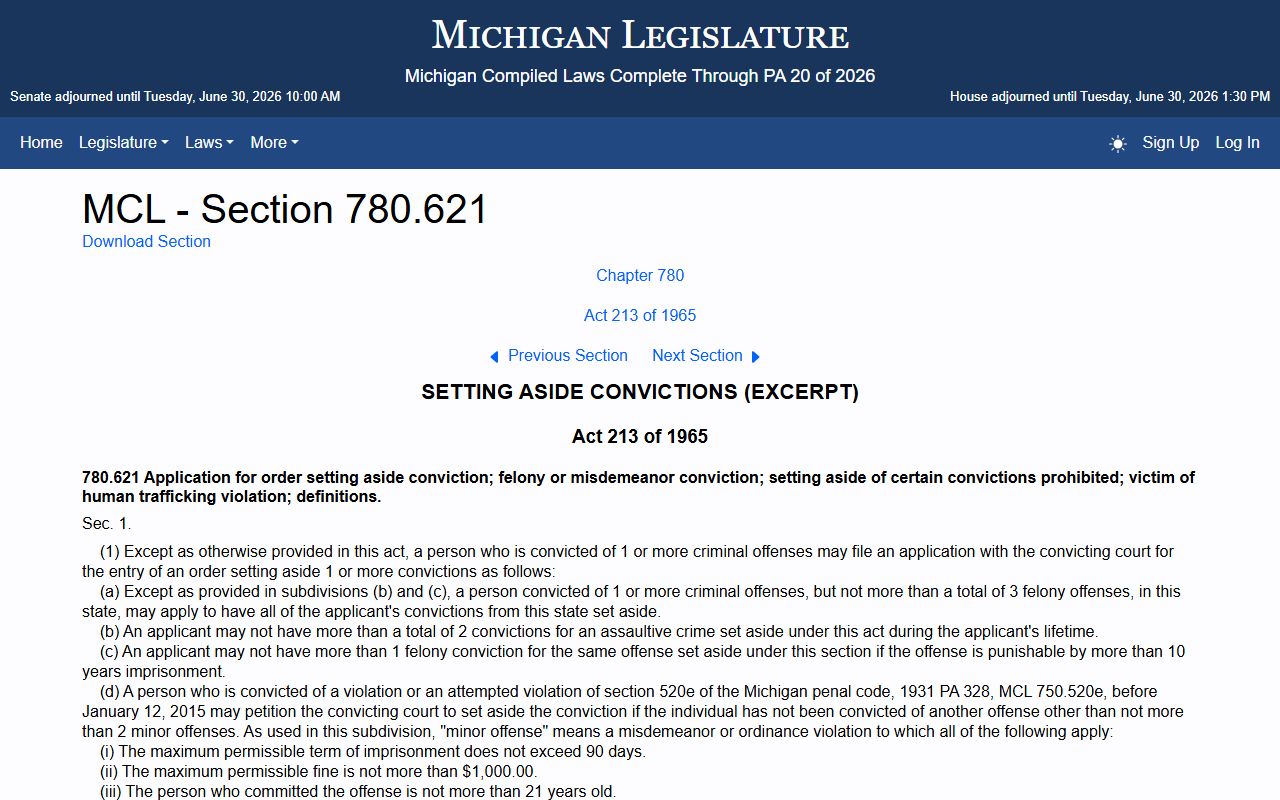
The application authority comes straight from statute. You can read Michigan MCL 780.621 for who may apply and which convictions can be set aside.
The path works best in order:
- Pin down the exact conviction, the court, the case number, and the disposition.
- Pull the case file from the court that entered the judgment, since a name search may not show suppressed records.
- Confirm whether the record already qualifies for an automatic set-aside or needs an application.
- File the set-aside forms, meet the eligibility rules, and serve the agencies the law names.
Timing can be uneven in Leelanau County right now. The 86th District Court paused extracting some criminal cases to its public website while it reconciled automatic set-aside records, which can limit older criminal web access and some online payments.
Note: A set-aside can take time to reach every system, so a record cleared in court may still show in an outside database until the update catches up.
Public Access to Leelanau County Criminal Court Records
Criminal case files are open by default in Michigan, and the rules that govern them sit in the court rules and the state's open-records law. Court records follow the Michigan Court Rules and local court procedure, while other public bodies fall under the Freedom of Information Act. For a sheriff or prosecutor record that is not a court file, a FOIA request to the county is the usual route.
Key Statutes:
Michigan MCL 15.233 - gives the public a right to inspect and copy public records unless a specific exemption applies.
Michigan Court Rule 8.119 - governs how trial courts keep, maintain, and release their case records.
Access has limits even when a file is public. Copy fees apply, document images may need a clerk request, and protected personal details stay redacted. For records beyond criminal cases, the county's court records overview maps the civil, family, and probate options.
Note: Michigan treats court files under its court rules rather than the open-records act, so a records request and a court copy request follow different tracks.
Victim-Witness Assistance in Leelanau County
Criminal cases carry rights for the people harmed by the crime. The Leelanau County Prosecuting Attorney runs a Victim-Witness Assistance program that acts as the link between victims, witnesses, and the court process. Its advocate handles crisis support, court preparation, and updates on where a case stands. You can review the Leelanau County Victim Assistance page for the services it offers.
The program covers a wide set of services. These include help understanding plea talks, a safe place to wait at court, aid with property release, and support filing for restitution and victim compensation. An advocate can also help a victim write an impact statement for sentencing.
Background Check Considerations
People read criminal court files for many reasons, from checking a name to vetting a landlord. A casual look at a public case file is not the same as a formal background check. Screening for a job, a lease, or credit falls under the federal Fair Credit Reporting Act, which sets strict rules on how a regulated report may be built and used.
Important: This website is not a consumer reporting agency under the Fair Credit Reporting Act, and its information cannot be used for employment, housing, credit, or other FCRA-regulated screening.
Restricted Criminal Court Records in Leelanau County
Not every criminal record is open. Juvenile cases are held apart and kept confidential by statute, so a young person's file is not part of the public search. You can read Michigan MCL 712A.28 for how the law guards juvenile record access.
Other files stay closed for their own reasons. Sealed and set-aside cases drop out of public view, and personal identifiers such as birth dates, Social Security numbers, and driver license numbers are redacted from what remains. Active investigations and some protected matters may be withheld while they are open. When a file will not load online, the court clerk can confirm whether it is restricted, in storage, or simply not yet posted.